Menu
Our Office
10/413 E, F . OPP SBOA SCHOOL, West Nada South Chittoor

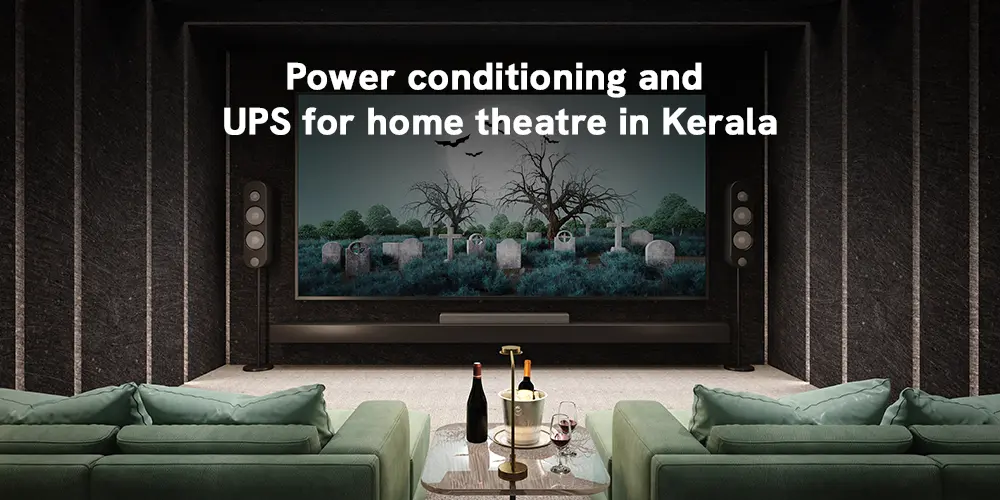
A premium home theatre system represents a substantial investment — one that demands not only precision in acoustic design, screen calibration, and equipment selection, but also an uncompromising approach to the electrical infrastructure that sustains it. In Kerala, where the power grid presents a unique and often underestimated set of challenges, the integrity of that infrastructure cannot be left to chance.
For systems valued upwards of ₹7 lakhs — comprising reference-grade 4K laser projectors, Dolby Atmos AV processors, multi-channel power amplifiers, and high-resolution source components — the consequences of inadequate power conditioning extend beyond equipment inconvenience. A single voltage event can cause irreversible damage to components that carry five- and six-figure replacement costs, and in many cases, voids manufacturer warranty coverage entirely.
This guide addresses the professional standards of power protection appropriate for high-end home theatre installations in Kerala, and why it must be treated as a non-negotiable element of any serious AV system design.
Why Kerala's Power Grid Is a Critical Threat to Premium AV Equipment
Kerala's electricity infrastructure presents a combination of challenges that are particularly hazardous for precision electronics.
The state's significant dependence on hydroelectric generation means that power supply quality fluctuates seasonally. <cite index="19-1">Kerala has experienced power crises where multiple districts faced cuts two to three times nightly, each lasting 15 to 30 minutes.</cite> Each interruption and restoration cycle introduces the risk of a transient voltage spike — precisely the type of event that destroys sensitive power supply circuits in high-end AV components.
The southwest monsoon amplifies this risk considerably. <cite index="22-1">Heavy monsoon rains and winds have previously caused widespread damage to Kerala's power infrastructure, damaging thousands of high and low tension poles and lines and cutting supply for millions of consumers.</cite> When damaged distribution lines and overloaded transformers restore supply, they frequently deliver unstable, transient-laden power into residential circuits.
At the distribution level, <cite index="14-1">storms, heavy rain, and humidity — especially during the monsoon season — directly affect power lines and electrical connections, leading to frequent voltage fluctuations.</cite> Reference-grade electronics from brands such as Classe, McIntosh, Anthem, and Sony's professional projector line operate within extremely tight voltage tolerances. Persistent supply instability significantly shortens component service life, even absent any dramatic failure event.
The Four Threats That Luxury AV Equipment Cannot Absorb
Understanding precisely how compromised power damages high-end electronics is essential to specifying the correct protection.
Transient Voltage Spikes and Surges represent the most acute risk. <cite index="17-1">Environmental factors such as lightning strikes, storms, and high winds can damage power lines or cause transient faults leading to short-term voltage instability.</cite> In a high-end system, these transients enter through power supplies and can propagate across internal signal buses, damaging DAC circuits, DSP boards, and output stage components — none of which are inexpensively replaceable.
Sustained Brownouts and Voltage Sags impose chronic stress on power amplifiers and projector lamp systems. When voltage drops significantly below nominal, high-current amplifiers draw compensatory current, generating excess heat and accelerating component wear. Projector lamp life, already measured in thousands of hours, diminishes measurably under persistent low-voltage conditions.
EMI and RFI Mains Noise is a particular concern at this level of system performance. <cite index="2-1">Power conditioners provide EMI and RFI filtering through suppression circuits that keep electromagnetic interference out of power supplies and associated audio circuits — spikes and surges can cause serious damage to equipment.</cite> In a system resolving the finest detail of a high-resolution audio source, mains noise manifests as measurable noise floor elevation, compromising the performance the equipment was designed to deliver.
Switching Transients from other household loads — air conditioning compressors, lifts in multi-storey residences, large induction motors — inject brief but cumulative disturbances. In an integrated home with automated lighting and climate control alongside a premium theatre room, the electrical environment is rarely benign without deliberate isolation.
The Three-Tier Protection Architecture for High-End Systems
Professional AV installations at this level require a structured, layered approach to power delivery — not a single device, but an engineered system.
Tier 1 — High-Precision Servo-Controlled Voltage Stabiliser
The foundation of any serious power protection installation in Kerala is a high-precision servo-controlled voltage regulator. For premium home theatre applications, this means specifying a unit with tight output regulation — ideally ±1% of nominal, not the ±5–10% that budget stabilisers offer.
<cite index="5-1">Wide-voltage-range stabilisers can operate reliably across 90V to 290V input in unstable power areas, and automatic voltage cutoff disconnects supply during unsafe conditions.</cite> For high-end installations, the stabiliser should be sized to handle the full system load — typically 3 to 5 KVA for a complete Atmos theatre with a high-lumen laser projector — with a 40% headroom margin to prevent thermal stress under dynamic load changes.
Tier 2 — Double-Conversion Online UPS with Pure Sine Wave Output
At the premium level, only a true double-conversion (online) UPS topology is acceptable. In this architecture, the connected equipment never runs directly off mains power; it runs continuously from the UPS inverter output, with the mains supply simply keeping the battery charged. There is zero transfer time during a power failure because no transfer actually occurs.
<cite index="6-1">A Voltage Stabiliser or Power Conditioner handles power quality issues like voltage fluctuations, surges, and noise, while the UPS provides backup power in the event of complete power loss — together creating two layers of protection for sensitive equipment.</cite>
The UPS must output pure sine wave power. High-end AV equipment — particularly Class A/B power amplifiers, reference projectors with motorised lens assemblies, and sophisticated AV processors — relies on the sinusoidal waveform of mains power for correct operation. Modified sine wave output from budget UPS units introduces harmonic distortion that manifests as audible hum, operational instability, and long-term component stress.
<cite index="3-1">An online UPS plays a dual role — charging the battery when mains supply is present while regulating output voltage, and working as a normal inverter in the absence of mains supply.</cite> For a flagship home theatre with a 4K laser projector, a high-current Dolby Atmos processor, and a multi-channel amplifier array, a 3 KVA online UPS is the appropriate starting specification, scaled upward based on the system's actual measured load.
Tier 3 — Professional-Grade AV Power Conditioner
The final and most performance-critical tier is a dedicated AV power conditioner positioned as the last stage before equipment connection. At this level, the reference products are those used in professional recording studios and broadcast facilities — brands such as Furman Reference Series, Panamax MR Series, and Torus Power.
These units provide several capabilities beyond simple surge protection. Isolated outlet banks prevent high-current components such as power amplifiers from injecting noise back onto the circuit that feeds source components. Series-mode surge protection — as found in Furman's Reference and Elite series — absorbs and dissipates surge energy rather than clamping and diverting it, offering superior protection without the degradation of clamping circuits over time. Advanced units include automatic voltage shutoff with configurable thresholds, current monitoring per outlet bank, and triggered sequential power-up sequencing to protect amplifiers from turn-on transients.
For a system at this investment level, the power conditioner is as much a performance component as a protection device. Clean, stable power is the platform on which every other aspect of system performance rests.
Entrusting Your Investment to the Right Specialists
Designing and implementing a power protection system for a premium home theatre requires both specialist AV knowledge and a thorough understanding of local electrical conditions. The load calculations, topology selection, equipment specification, and installation must be executed with precision — the same precision applied to every other element of a high-end AV installation.
Cine Galaxy is Kerala's specialist in premium home theatre design and installation, with dedicated expertise in complete electrical infrastructure planning for high-end AV environments. Every installation delivered by Cine Galaxy includes a professionally engineered power protection system — stabiliser, UPS, and AV-grade power conditioner — specified to the precise requirements of the system and the installation site.
From luxury home theatre design and installation in Kerala to the rigorous power conditioning standards that protect it, Cine Galaxy approaches every project as the integration of a complete, engineered system — not an assembly of components.
A system of this calibre deserves infrastructure designed to the same standard. Visit Cine Galaxy to arrange a consultation with Kerala's premium home theatre specialists.