Menu
Our Office
10/413 E, F . OPP SBOA SCHOOL, West Nada South Chittoor

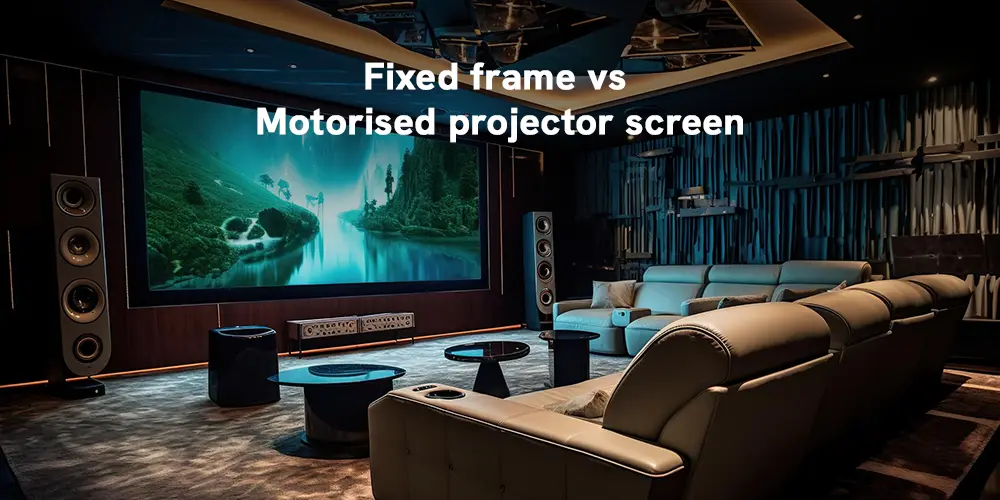
You've spent months planning your dream home theatre. You've picked the projector, sorted the seating, even argued with your interior designer about acoustic panels. And then you hit the one decision that trips up almost every Kerala homeowner: fixed frame or motorised projector screen?
What Is a Fixed Frame Projector Screen — and Who Is It Actually For?
A fixed frame screen is exactly what it sounds like: a taut, tensioned screen fabric permanently stretched over a rigid aluminium frame and mounted on your wall. It doesn't retract, doesn't roll, doesn't do anything fancy. It just sits there — dead flat, wrinkle-free, ready to display.
That flatness is its superpower. Because the fabric is under constant, even tension, you get a perfectly uniform surface with zero waviness or sagging. For anyone obsessed with image quality — and home theatre enthusiasts usually are — this matters more than most people realise. Even a slight bow in the screen surface can create noticeable distortion, especially with ultra-short-throw projectors.
Fixed frame screens work best when:
- Your home theatre is a dedicated room (not a multi-purpose hall or drawing room)
- You want the best possible image sharpness and gain consistency
- Your budget is tighter — fixed frame screens cost noticeably less than motorised ones at equivalent quality
- You're not concerned about hiding the screen when not in use
The downside is obvious: that screen is always there. In a dedicated theatre room, that's fine — even desirable, since it sets the mood. But in a Kerala home where the same room doubles as a family sitting area or pooja room on one end, a large black rectangle on the wall can feel like an intrusion.
Motorised Screens: The Practical Choice for Dual-Purpose Spaces
A motorised projector screen retracts into a housing (ceiling-mounted, wall-mounted, or recessed into a ceiling cassette) and descends at the press of a button or on a smart home command. When you're not watching, the screen disappears entirely.
This is the version most Kerala homeowners lean toward when the theatre is carved out of a living room, a family lounge, or a large open-plan space — which, given the typical layout of Kerala homes, is more common than you'd think.
Modern motorised screens are impressively quiet, and high-end versions offer tab-tensioning (side rails that keep the fabric flat as it unrolls). Without tab-tensioning, the fabric can develop ripples in the center, which is where many budget motorised screens fail.
Motorised screens work best when:
- The space doubles as a living room, entertainment hall, or any non-dedicated room
- You want a cleaner aesthetic when the screen is retracted
- You're investing in a smart home setup where automation is already part of the plan
- You have the budget for a quality, tab-tensioned model (important — more on this below)
The trade-offs are real, though. Good motorised screens cost significantly more. The motor mechanism adds a maintenance point that fixed frames simply don't have. And in Kerala's humidity, cheap motorised screens with fabric that doesn't breathe well can develop mold or warping inside the housing over time if not properly ventilated.
The Kerala Factor: Why Climate Matters More Than You Think
This is the part most YouTube comparisons skip — and it's arguably the most important consideration for anyone setting up a home theatre in Kerala.
Kerala's average relative humidity sits between 75–90% for much of the year, spiking even higher during the monsoon. What does that mean for your screen?
For fixed frame screens: The fabric is always exposed to the room's ambient air, which means proper ventilation and air conditioning in the theatre room matters. Most quality fixed frame screens (PVC-coated or matte white fabric) handle humidity reasonably well — but the aluminium frame can develop surface oxidation over years if the room is poorly ventilated. The solution is straightforward: keep the room air-conditioned or properly dehumidified, which you'd want anyway for your projector's optics.
For motorised screens: The housing is the concern. When a screen retracts into a ceiling or wall cassette, it coils or folds inside a closed (or semi-closed) enclosure. If moisture gets trapped there — and in Kerala it absolutely can — the fabric can develop mildew or the motor's internal components can corrode prematurely. This is why spending on a quality brand with proper ventilation slots in the housing is not optional here — it's essential.
A practical tip from experience: if you're going motorised in Kerala, always opt for a tab-tensioned screen with a vented cassette housing, and have your AV installer ensure the motor housing is not flush against a damp wall or in a space with zero air circulation.
Image Quality Showdown: Is There Actually a Visible Difference?
Yes — but it depends on how much you notice.
Fixed frame screens win on pure picture quality. The constant tension keeps the screen perfectly flat, and the fabric lies uniformly at the correct gain angle. This means every pixel from your projector hits the screen surface at the right angle and reflects cleanly toward your seating area.
Motorised screens — especially those without tab tensioning — can develop slight center sag or edge curl over time. You may not notice it on a casual movie night. But on bright, high-contrast scenes (think: snow, a white room, an overcast sky), subtle screen irregularities become visible.
The verdict: For dedicated home theatres with serious cinephile users, fixed frame is the image quality choice. For a multi-use family room where the whole family watches cricket and Malayalam films, a quality motorised screen will be more than good enough — and the ability to hide it when not in use is worth more than a marginal picture improvement.
Budget Reality Check for Kerala Buyers
Prices vary depending on screen size (100" and 120" being the most popular for home theatres here) and brand. Here's a rough guide for the Indian market:
| Screen Type | Entry-Level (INR) | Mid-Range (INR) | Premium (INR) |
|---|---|---|---|
| Fixed Frame (100") | ₹8,000 – ₹18,000 | ₹20,000 – ₹45,000 | ₹50,000+ |
| Motorised (100", no tab tension) | ₹12,000 – ₹25,000 | — | — |
| Motorised Tab-Tensioned (100") | ₹35,000 – ₹60,000 | ₹65,000 – ₹1,20,000 | ₹1,50,000+ |
The key takeaway: a mid-range fixed frame screen will outperform an entry-level motorised screen in image quality, at a lower price. If your budget is under ₹30,000 and you have a dedicated room, fixed frame is almost always the smarter choice.
5 Questions to Ask Yourself Before You Decide
1. Is this a dedicated theatre room or a multi-use space?
Dedicated → lean fixed frame. Multi-use → motorised wins on livability.
2. What's your screen size?
Above 120 inches, motorised screens with tab-tensioning become much harder to source affordably in Kerala's local AV market. Fixed frame options at large sizes are far more widely available.
3. Do you have a smart home system?
If yes, motorised screens integrate beautifully with Alexa, Google Home, or Control4 setups. Fixed frames don't need to.
4. Is your room air-conditioned or temperature-controlled?
Kerala humidity affects both types differently. If the room runs AC for most of the year, either works fine. If it's a naturally ventilated room, a fixed frame in a well-aired space may actually be more resilient than a motorised screen with a sealed housing.
5. How important is install simplicity?
Fixed frames are genuinely DIY-friendly. Motorised screens — especially ceiling-recessed versions — need professional installation and electrical work.
The Honest Recommendation
There's no universally right answer, but here's how most Kerala home theatre buyers end up deciding:
Go fixed frame if you have a dedicated room, care deeply about image quality, and want to keep costs down without compromising the viewing experience. You'll get the best picture, the least maintenance, and the highest reliability over time.
Go motorised if your home theatre lives inside a family hall or living space, you want the screen out of sight when guests arrive, or smart home integration is already part of your setup — but invest in a quality tab-tensioned model with a vented housing. Don't cut corners here; a cheap motorised screen in Kerala's climate will disappoint you within two monsoon seasons.
The screen is, ultimately, where every single hour of content you watch in that room will live. It's worth one careful decision.