Menu
Our Office
10/413 E, F . OPP SBOA SCHOOL, West Nada South Chittoor

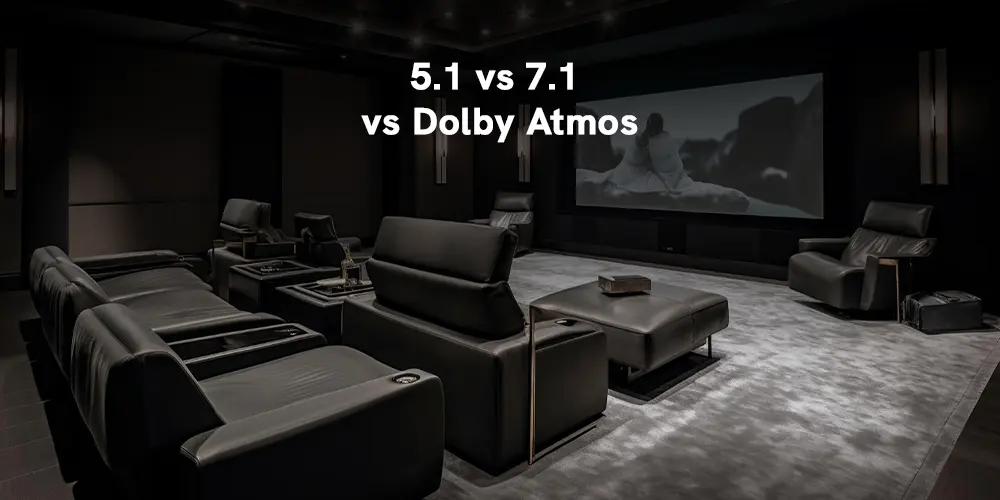
If you are enthusiastic about setting up a home theatre, the first thing come to mind is the kind of speaker setup. Nowadays, a variety of options are available, and people are ready to spend more money depending on the immersiveness they can experience while watching a movie or Netflix series. Perhaps a game. From 5.1 surround sound to more established Dolby Atmos, the options are multiple. In this blog, you will get to know the basics of 5.1, 7.1 and Dolby Atmos, and we will dig in detail 5.1 vs 7.1 difference.
| Feature | 5.1 Surround Sound | 7.1 Surround Sound | Dolby Atmos |
|---|---|---|---|
| Audio Type | Channel-based | Channel-based | Object-based 3D audio |
| Number of Channels | 5 speakers + 1 subwoofer | 7 speakers + 1 subwoofer | Example: 5.1.2 (includes height channels) |
| Sound Experience | Basic surround (360°) | Enhanced rear surround | Full 3D immersive sound (including overhead) |
| Room Size Suitability | Small to medium rooms | Medium to large rooms | Works best in well-designed rooms |
| Installation Complexity | Easy | Moderate | Advanced setup required |
| Budget | Budget-friendly | Mid-range | Premium |
| Best For | Movies, TV, small spaces | Large rooms, gaming | High-end home cinema experience |
| Immersion Level | Good | Better | Best (cinema-level) |
Home theatre setup and surround system
Home theatre setup is redefined day by day with more technological interventions and immersive sound experience. Multi-channel surround systems of different types, such as 5.1, 7.1, and Dolby Atmos, exist. These offer a richer perceptual experience than traditional stereo reproduction. Let us dig into the details.
What is 5.1 surround sound?
5.1 surround system is an entry point of home theatre to an immersive experience. It creates an immersive, 360-degree soundstage by using six distinct audio channels to separate dialogue, music, and sound effects. It ensures more accurate and stable localisation of sound sources. The front centre channel is equidistant between the main left and right front loudspeakers and impacts upon imaging in the front arc of 60º.
The left and right surround loudspeakers provide the possibility to extend localisation beyond the front arc into the full horizontal 360º. Surround sound provides an opportunity to create something that works over a much wider range of listening positions than two-channel stereo, does not collapse rapidly into the nearest loudspeaker when one moves, and enhances the spatial listening experience.
Features
- 5 full bandwidth channels and one low frequency
- Standard format Dolby Digital or DTS
Benefits
- Cinematic immersion
- Crystal clear dialogue clarity
- Deep, high-impact bass
- Widespread compatibility
- Suitable for gaming too
Applicability
- 5.1 surround sound is a better option if you have a studio room or a small living room
- Constrained budget
- If you prefer a simple immersive setup
What is 7.1 surround sound?
7.1 is a speaker arrangement in current use in the theatres. It is basically an eight-channel audio configuration that enhances the home theatre experience by adding two additional channels to a standard 5.1 setup. It is particularly effective in larger rooms (typically over 300 square feet) to create a more immersive and detailed soundstage.
In a 7.1 surround system, you place five full-range speakers behind the screen — left, left centre (“left extra”), centre, right centre (“right extra”), and right — along with two arrays of rear surround speakers, plus a subwoofer. The main advantage of this system is improved localisation, particularly when applied to dialogue. For example, two "talking heads" onscreen might be assigned to the left centre and right centre speakers, with the soundtrack panned hard left and right and sound effects routed to the centre channel.
Features
- 5 full bandwidth channels and one low-frequency channel
- Standard format Dolby Digital or DTS
Benefits
- Enhanced rear immersion
- Competitive gaming advantage
- High-fidelity audio support
- Seamless 360-degree circle of sound
Applicability
- 5.1 surround sound is a better option if you prefer a budget-friendly yet highly immersive experience
- Optimised for big rooms
- Your room must have soft furnishings to obstruct echoes or muddy sound
What is Dolby Atmos?
Dolby Atmos is an object-based immersive audio technology that moves beyond traditional channel-based systems (5.1/7.1) to create 3D soundscapes, allowing sound to be precisely placed and moved in three-dimensional space. Dolby Atmos configurations use a three-number system (e.g., 5.1.2) representing ear-level speakers, subwoofers, and height channels.
It is widely acknowledged as the best immersive experience for a home cinema because of its realistic sound. Besides, the system can automatically adjust your audio configuration for a specific speaker and have precise sound reflection in a controlled space.
Features
- 3-dimensional and sounds are precisely positioned for immersiveness
- Standard for many cinema, games, and streaming platforms
- Height cahneels
- Flexconnect
- Mobile experience
Benefits
- Enhanced immersive experience
- Utmost dialogue clarity
- High-end gaming experience attainable
- Precise and realistic
- Highly scalable
Applicability
- With a suitable room environment and acoustic treatment, you can adopt it.
Which one is suitable for a home theatre in Kerala?
The question is truly personal. The answer depends on several factors such as room environment, budget, acoustics and the kind of immersive experience you want to enjoy. For budget friendliness and basic immersive experience in a compact room, you need to go for 5.1. In case you can put a little more money, you can select 7.1 as it provides crystal clear dialogue delivery with additional speaker setup in a large room. Many go for Dolby Atmos because it is the ultimate when it comes to home theatre experience. This kind of surround setup is the best if you have abundant space, budget and expectations. Above all, it is highly scalable.
Cinegalaxy is adept at Dolby Atmos home theatre Kerala services, as we have successfully set up Dolby Atmos in several homes throughout Kerala. If you are into developing a home theatre, you can count on us for every detail.
Faq
1. What is the main difference between 5.1 and 7.1 surround sound?
The primary difference is the number of speakers. A 5.1 system uses five speakers and one subwoofer, while a 7.1 system adds two extra rear speakers, delivering better sound depth and rear-channel immersion.
2. When should I upgrade from 5.1 to 7.1 surround sound?
You should consider upgrading to 7.1 if you have a larger room (typically above 300 sq. ft.) and want enhanced rear sound effects, better sound localisation, and a more cinematic experience.
3. What makes Dolby Atmos different from 5.1 and 7.1 systems?
Dolby Atmos uses object-based audio technology, allowing sound to move freely in a 3D space, including overhead. Unlike traditional systems, it adds height channels for a more realistic and immersive experience.
4. What factors should I consider before choosing a surround sound system?
You should consider room size, budget, acoustic treatment, installation complexity, and your preferred level of audio immersion before selecting a system.
5. Does room acoustics affect surround sound performance?
Absolutely. Soft furnishings, curtains, and acoustic panels help reduce echo and improve clarity, especially in systems like 7.1 and Dolby Atmos.