Menu
Our Office
-
10/413 E, F . OPP SBOA SCHOOL, West Nada South Chittoor

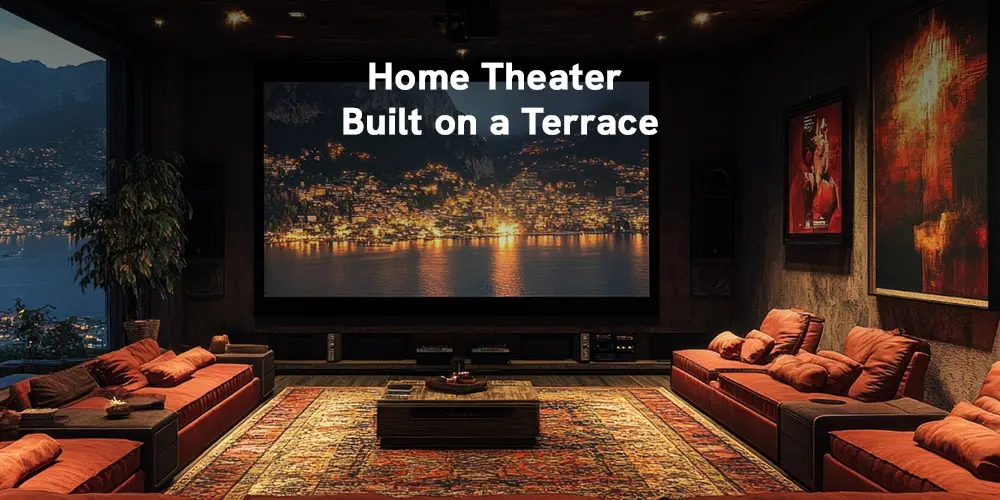
There's a question that comes up more often than you'd think during home theater consultations: "I don't have a spare room — but I have my terrace. Can we do something with that?"
The answer is yes. And more often than not, it turns out to be the best possible answer.
Building a dedicated home theater room on your terrace isn't a compromise. It's actually one of the most acoustically and architecturally sound ways to create a cinema space — and when done correctly, it delivers an experience that no repurposed bedroom or living room system can come close to matching.
This guide walks through the entire process: from structural groundwork and room design to acoustic treatment, display systems, and the high-end audio configurations — Dolby Atmos, Auro-3D, DTS:X — that transform a new room into a reference-grade private cinema.
Why a Terrace Is One of the Best Locations for a Home Theater Room
Before getting into the how, it helps to understand why the terrace works so well. Most people assume it's a second-choice location. In practice, it has genuine advantages over almost any room inside the main house.
Acoustic separation from the living structure. When your theater is built on the terrace slab, it sits physically above the rest of the home. Bass-heavy film soundtracks — the kind your subwoofer produces during an action sequence — transmit far less into the bedrooms and living areas below, compared to a theater built directly against shared interior walls.
Freedom in room dimensions. Every home theater designer will tell you that room dimensions are one of the most important acoustic variables. In an existing room, you're stuck with whatever size it is. On the terrace, you design the room from scratch — choosing the length, width, and ceiling height that minimize problematic bass resonances and give you the best starting point for acoustic treatment.
No compromise with other uses. A terrace theater room is built for cinema and nothing else. There's no dining table to work around, no sofa arrangement that's also meant for casual TV viewing. The space exists entirely on its terms.
Phase 1: Civil Construction — Building the Room Right
The foundation of any great home theater is, literally, the room itself. This phase cannot be rushed or value-engineered, because every shortcut taken here compounds into problems that expensive equipment cannot fix.
Structural Assessment First
Before a single block is laid, a structural engineer must evaluate your existing terrace slab. The slab was designed for a specific load — general foot traffic, perhaps a water tank. You're now proposing to add walls, a roof structure, acoustic materials, seating, and AV equipment. That load needs to be calculated and the slab assessed for adequacy. In some cases, beam reinforcement is required. In most cases with newer construction, the slab is sufficient for a lightweight room — but you need an engineer's sign-off, not an assumption.
Wall Construction and Sound Isolation
For a terrace theater, a steel frame with double-layer gypsum board is typically preferred over traditional AAC block construction. It's lighter (important for load management), faster to build, and — critically — it allows for a decoupled wall system. In a decoupled wall, the inner surface of the room is mounted on resilient channels rather than attached rigidly to the frame. This breaks the vibration path between the inner wall and the outer shell, significantly reducing bass transmission into the building below.
Wherever possible, wall cavities should be filled with acoustic mineral wool (not just thermal insulation). This dramatically improves mid-frequency isolation.
Door and penetration sealing matters more than most people expect. A single unsealed gap around a door frame or cable entry point can undo much of the isolation work done by the walls. Acoustic door seals, drop seals, and properly sealed conduit entries are not optional.
Thermal Insulation and Waterproofing
A terrace room is exposed to direct solar radiation on the roof. Without proper insulation, the room becomes a heat chamber by afternoon — uncomfortable for viewers and damaging for electronics. EPS boards, polyurethane foam, or multi-layer reflective foil systems under the finished ceiling keep internal temperatures manageable and significantly reduce air conditioning load.
Waterproofing must be addressed at the slab junction — the meeting point between your existing roof and the new room's walls. This is the most common point of water ingress in terrace construction. Membrane waterproofing, properly dressed into the wall base, keeps the room and all its equipment protected through monsoon season.
Phase 2: Acoustic Room Design — The Science Behind the Experience
If the construction phase builds the shell, acoustic design is what turns that shell into a room where sound behaves the way it should. This is the difference between a home theater that impresses on paper and one that actually delivers on the couch.
Room Dimensions and Modes
Every enclosed space has resonant frequencies — room modes — determined by its physical dimensions. When modes are poorly distributed, bass piles up unevenly: boomy in one seat, thin in another, and no amount of subwoofer adjustment fully corrects it. The goal in room design is to choose dimensions where modes spread as evenly as possible across the frequency range.
Standard guidelines like the Bolt area criteria or ITU listening room ratios give a starting point. For a terrace room where you have freedom to choose dimensions, targeting a width-to-height ratio of roughly 1.25:1 and a length-to-width ratio of 1.6:1 or greater distributes modes well. An acoustic consultant can model your specific dimensions before construction finalizes.
The Floating Floor
A floating floor — where the finished floor surface rests on resilient isolation pads rather than directly on the slab — is one of the highest-impact investments in a theater room. It isolates the room from structural vibration, dramatically reduces low-frequency transmission downward, and creates a clean cavity beneath the floor for concealed cable runs. This is the correct way to handle cable management in a high-end installation: conduits beneath the floor, not surface-mounted raceways.
Interior Acoustic Treatment
Once the room is built, acoustic treatment addresses how sound behaves within the space. A home theater room should have a reverberation time (RT60) of approximately 0.3–0.4 seconds — controlled and focused, without being dead or anechoic.
The treatment approach combines three elements:
Bass traps are placed in corners — both floor-to-ceiling vertical corners and ceiling-to-wall horizontal corners — where low-frequency energy concentrates most heavily. Thick, dense absorption (mineral wool or recycled cotton at 100mm or greater depth) is required to genuinely absorb bass rather than just scatter it.
Mid/high-frequency absorption panels are positioned at first reflection points on the side walls and the rear wall. These reduce early reflections that arrive at the listening position shortly after the direct sound, which would otherwise smear stereo imaging and dialogue clarity.
Diffusion panels — typically QRD or skyline diffusers — go on the upper rear wall and optionally portions of the ceiling. Diffusion scatters sound energy in a controlled way, maintaining the sense of spaciousness and room liveliness that pure absorption would kill.
The combination of these elements, tuned to the specific room, produces the kind of even, natural acoustic environment where a well-designed audio system can actually perform to its potential.
Phase 3: The Display System
In a fully light-controlled, dedicated theater room, projection is the clear choice for the main display. The image sizes achievable with projection — 120 inches, 150 inches, even larger — are simply not available at any price in flat-panel technology, and in a dark room, a well-calibrated projection system looks extraordinary.
Advanced laser projectors represent the current standard for home theater. Unlike traditional lamp projectors, laser light engines maintain consistent brightness over their entire lifespan without lamp replacement, deliver a wider color gamut covering more of the DCI-P3 color space used in cinema mastering, and switch on instantly without warmup cycles.
At CineGalaxy, our Advanced Laser Projector systems are specified for dedicated room installations — selected for throw ratio compatibility with your room dimensions, native 4K resolution, and color volume performance that justifies the investment in a properly treated room.
Projector screens for a dedicated theater should be acoustically transparent wherever the speaker layout places the front three channels (left, center, right) behind the screen — which is the correct configuration for any serious home cinema. Acoustically transparent fabric allows sound to pass through cleanly at all frequencies, so your left, center, and right speakers sit exactly where they should: directly behind the screen surface, exactly as in a commercial multiplex.
CineGalaxy's Projector Screen range includes options sized and specified for dedicated rooms — from standard gain to acoustically transparent configurations for behind-screen speaker placement.
Phase 4: The Audio System — Dolby Atmos, Auro-3D, and DTS:X
This is where a terrace home theater built and treated correctly genuinely separates itself from any living room system. A properly designed room, with calibrated speakers at correct positions, playing Dolby Atmos or Auro-3D content is an experience that is simply not comparable to anything else in home entertainment.
What Immersive Audio Actually Means
Traditional surround sound — 5.1, 7.1 — places sound around you in a horizontal plane. Dolby Atmos, Auro-3D, and DTS:X add a vertical dimension. Sound moves above you, at head height, and below. A helicopter doesn't just pass left-to-right; it tracks over your head. Rain falls from above. A concert hall's acoustic fills the height of the space.
In a room with ceiling-mounted or overhead speakers, this height information is delivered precisely. In a living room, ceiling speakers are usually impractical. In a purpose-built terrace theater room, they're standard.
Speaker Systems: JBL Professional Grade
CineGalaxy's speaker systems are drawn from JBL's professional audio lineup — the same family of transducers used in commercial cinemas worldwide. This is not marketing language. JBL Professional supplies loudspeakers to thousands of commercial screens globally, and the acoustic DNA of those systems is what we bring into residential installations.
JBL ScreenArray Series Speakers are designed specifically for behind-screen placement in cinema configurations. Featuring high-sensitivity drivers and consistent horizontal coverage, they deliver clear, powerful audio across the full seating area — not just the sweet spot in the center. For a terrace theater where you'll have multiple seating positions, consistent coverage matters enormously.
JBL C211 Two-Way Screen Array (300W) provides a focused, high-output option for rooms where controlled directivity and efficiency are priorities. The two-way design handles midrange articulation — dialogue, vocal texture, orchestral detail — with the precision that film soundtracks demand.
JBL 9350 Professional Loudspeaker and the JBL NXLC21300 (1300W) represent the system's high-power backbone — capable of clean, dynamic output at reference listening levels (85dB SPL with 20dB of headroom) without compression or distortion.
For surround and overhead channels in a Dolby Atmos or Auro-3D layout, CineGalaxy's Surround Speaker range completes the 3D sound field — delivering the height and enveloping spatial information that makes immersive audio work.
Amplification: Crown Professional
Speaker performance is only as good as the amplification driving it. CineGalaxy uses the Crown XLC 2500 Power Amplifier — a professional-grade unit delivering high-power output with the thermal stability and low distortion that extended, demanding home theater use requires. Crown amplification is the professional standard in installed sound; using it in a residential context means your system has the headroom to handle reference-level playback without straining.
Audio Processing: Digital Cinema Processor
The Digital Cinema Audio Processor is the system's brain — decoding Dolby Atmos, Auro-3D, and DTS:X signals, applying room correction, managing speaker delays and levels, and routing audio to every channel in the system. In a correctly treated room, the combination of professional processing and professional speakers — calibrated together with measurement software — produces a result that meets or exceeds commercial cinema standards.
AV Receivers
For installations where a full processor-amplifier separation isn't required, CineGalaxy's AV Receiver options provide integrated decoding and amplification in formats supporting the latest immersive audio standards — configured and calibrated for the specific room during installation.
Immersive Audio Formats: What to Choose for Your Room
Dolby Atmos is the most widely supported immersive format. Virtually all major streaming platforms — Netflix, Amazon Prime, Apple TV+ — now offer Atmos-mixed content. For a new home theater installation in 2026, Atmos compatibility is baseline.
Auro-3D is the format Cine Galaxy specializes in. Where Dolby Atmos treats overhead speakers as additional point sources for sound objects, Auro-3D uses a fixed speaker layout — typically a 9.1 or 13.1 arrangement with a dedicated "Voice of God" speaker directly overhead — to deliver an enveloping, three-dimensional soundfield that is particularly compelling for music and concert content. In a dedicated room where speaker placement is fully controlled, Auro-3D is a genuinely unique experience.
DTS:X is the DTS equivalent of Atmos — object-based, flexible in speaker configuration, and widely supported across Blu-ray and streaming sources.
Many high-end installations support all three formats simultaneously through a compatible processor, allowing the room to deliver whatever the content demands.
Seating, Lighting, and Automation
Seating for a dedicated terrace theater should be specified for the room rather than brought in from a furniture showroom. Proper theater recliners with motorized recline, positioned at the calculated optimal distance from the screen, and arranged with appropriate spacing between rows, are the correct solution. For a two-row layout, a raised rear platform — typically a 300–400mm step — ensures clear sightlines from the back row over the heads of front-row viewers.
Lighting should be dimmable, warm (2700–3000K), and indirect. Recessed cove lighting, aisle step lights integrated into the seating riser, and ambient perimeter lighting that dims smoothly as the film starts are the standard elements of a well-designed theater room.
Automation ties everything together. A properly integrated system — projector, screen, audio processor, amplifiers, lighting, air conditioning — responds to a single command. One button press, one scene, or one voice command starts the sequence: lights fade, screen descends, projector powers up, processor selects the right input, and the room is ready. Systems from Control4, Crestron, or similar platforms make this seamless.
What Does It Cost to Build a Terrace Home Theater in Kerala?
There's no single answer, because there's no single configuration. A complete terrace home theater room — civil construction, acoustic treatment, JBL professional audio system, laser projection, display, seating, lighting, and automation — typically ranges from ₹15 lakh on the entry end to ₹60 lakh and above for a reference-grade installation.
The variables are significant: room size, speaker count and model, projector specification, structural complexity, seating count, and automation depth all affect the final number. What doesn't change is the principle: a properly built, correctly specified system built once costs considerably less than a system built wrong and rebuilt.
Cine Galaxy has been designing and building home theaters since 2008. Our terrace installations are built with professional-grade JBL audio, Crown amplification, and advanced laser projection — specified and calibrated for each room.
Frequently Asked Questions
1. Is a terrace home theater better than a room inside the house?
In most cases, yes — if the room is built correctly. The terrace offers freedom in room dimensions, natural acoustic separation from living areas, and no compromise with existing uses. A dedicated room built from the ground up almost always outperforms a conversion.
2. What speaker configuration should I use for a terrace theater room?
For immersive audio (Dolby Atmos, Auro-3D, DTS:X), a 7.1.4 configuration — seven surround channels, one subwoofer, four overhead channels — is the standard starting point for a properly sized dedicated room. CineGalaxy designs speaker layouts based on the specific room dimensions and seating arrangement.
3. Do I need building permission to construct a room on my terrace in Kerala?
Yes, in most cases. Adding a permanent structure to your terrace typically requires an amendment to your approved building plan. Requirements vary by local authority and plot classification — consult your local panchayat or municipality, and engage a licensed architect for the civil drawings.
4. How long does a complete terrace theater project take?
Civil construction typically runs 6–10 weeks. AV installation, acoustic treatment, and calibration add 3–5 weeks. A complete project from site assessment to first screening generally runs 3–4 months.