Menu
Our Office
10/413 E, F . OPP SBOA SCHOOL, West Nada South Chittoor

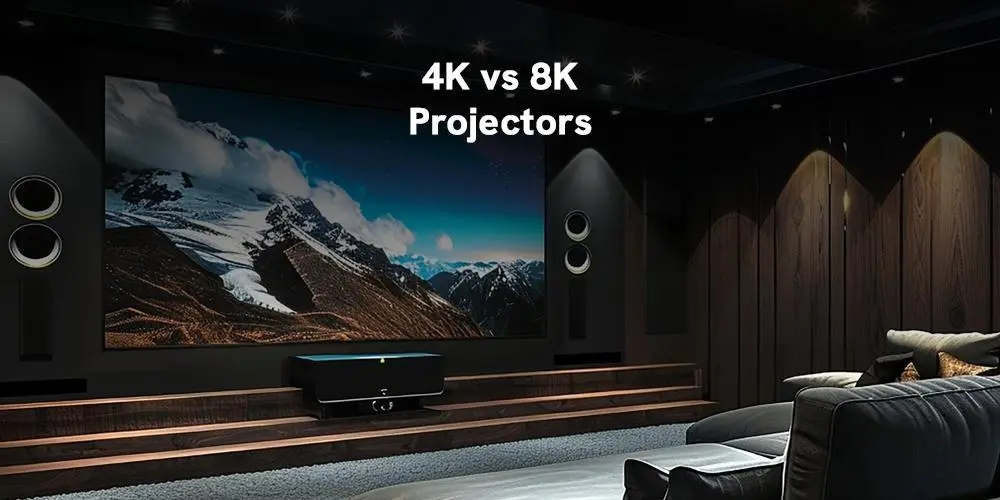
You've just upgraded your living room into a proper home theatre. The screen is up, the surround sound is dialed in, and now you're staring at projector spec sheets trying to figure out if 8K is the next logical step - or just expensive marketing.
Here's the honest answer: it depends. But let's break down what it depends on, because the 4K vs 8K conversation in 2026 is a lot more nuanced than resolution numbers alone.
What's Actually Changed in 2026
A few years ago, 8K projectors were aspirational objects - the kind of thing you'd see at trade shows behind velvet ropes. Not anymore. Prices have dropped significantly. You'll find credible 8K laser projectors in the ₹7.6 Lakhs to ₹14.3 Lakhs INR range now, whereas entry-level 4K home theater projectors start well under ₹1.5 Lakhs.
That price gap still matters. But the conversation has shifted from "can I afford 8K?" to "will I actually see the difference in my setup?"
That's a much better question.
The Resolution Reality Check
8K means 7680 × 4320 pixels — four times the pixel count of 4K (3840 × 2160). On paper, that's a massive leap. In practice, your ability to perceive that difference depends almost entirely on two variables: screen size and seating distance.
Here's a simple rule of thumb used by display engineers: to fully resolve 8K detail, you'd need to sit within about 1.5x the screen height. For a 150-inch screen, that puts you roughly 5–6 feet away. Most home theater setups have seating 12–18 feet back. At that distance, the difference between a sharp 4K image and a true 8K image becomes borderline imperceptible to the human eye.
That doesn't mean 8K adds nothing — pixel density improvements contribute to a smoother, slightly more "film-like" texture on large screens. But it's not the dramatic jump that going from 1080p to 4K was.
Where 8K Actually Makes a Difference
Screen size is the big one. If you're projecting onto a screen larger than 180 inches and sitting closer than most people do think dedicated screening room with stadium seating 8K starts to show its value. The image holds its sharpness in a way that even premium 4K projectors can't fully match at that scale.
Upscaling quality. Modern 8K projectors come with genuinely impressive AI upscaling engines. Since virtually no native 8K content exists for home use yet (streaming services haven't caught up, and 8K Blu-ray is still not a thing), these projectors are spending most of their time upscaling 4K content. The upscalers built into flagship 8K projectors from brands like Sony, JVC, and Epson are among the best in the business - and that does translate to a noticeably cleaner image, even from 4K source material.
Future-proofing. If you're building a permanent home theater and don't plan to touch the projector for 10+ years, 8K makes more sense as an investment today than it would have in 2023.
The Case for Staying With 4K (It's a Strong Case)
Let's be direct: for most home theatre setups in 2026, a high-end 4K projector is still the smarter buy.
The reason is simple. The quality ceiling of 4K hasn't been reached by content yet. The best 4K streaming and 4K Blu-ray titles look extraordinary on a well-calibrated 4K laser projector. You're not sitting there wishing for more resolution - you're sitting there with your jaw open because the image is genuinely cinematic.
Meanwhile, 8K content pipelines for home entertainment are still thin. Yes, there are 8K YouTube videos. Yes, some video games can output at 8K with the right hardware. But the bulk of what you'll watch movies, TV shows, sports - is being delivered in 4K or lower. Spending an additional ₹9.5 Lakhs to ₹20.3 Lakhs INR for an 8K projector means paying a premium to watch 4K content on an upscaler.
That's not a terrible trade-off if you have the budget and the setup to support it. But for most people, it's not where the money is best spent.
Where to Spend That Budget Instead
If you're debating between a ₹2.8 Lakhs 4K projector and a ₹13.8 Lakhs 8K projector, here's what that extra ₹10.5 Lakhs could get you instead:
- A proper acoustic treatment for your room (which affects perceived picture quality more than you'd think)
- A premium motorized screen with ambient light rejection
- A Dolby Atmos speaker upgrade that will absolutely transform every watching experience
- A better subwoofer that makes you feel the movie, not just hear it
Picture quality isn't just resolution. Contrast ratio, black levels, color volume, and motion handling are areas where a well-specced 4K projector can genuinely rival — and sometimes beat — a mid-range 8K competitor that's cutting corners elsewhere.
The Projectors Worth Knowing About in 2026
If you're shopping right now, here are the categories that matter:
Best-in-class 4K: The JVC NZ-series and Sony VPL-XW series continue to dominate for home theater purists. Native 4K panels, exceptional contrast with laser light sources, and color accuracy that's hard to fault.
Mid-range 4K sweet spot: Epson's EpiqVision series and Optoma's UHZ range offer serious value between ₹2.8 Lakhs to ₹4.5 Lakhs. You're not sacrificing much to get there.
8K if you're ready: Sony's VPL-VW5000ES successor and JVC's flagship 8K lineup are the reference-class options. Expect to pay for the privilege, and make sure your room actually justifies it before pulling the trigger.
So, Is the Upgrade Worth It?
For a 150-inch screen at 15 feet? No. Your money works harder in a premium 4K setup.
For a 200-inch dedicated screening room at closer viewing distances with no budget ceiling? Yes — 8K earns its place, especially with the upscaling quality of today's flagship units.
The honest truth is that the home theatre market in 2026 is in an interesting limbo. 8K projectors are technically ready. The content ecosystem isn't fully there yet. Give it another 3–5 years and that equation flips — at which point, 8K will be a genuine no-brainer if you're building new.
For now, buy the best 4K setup you can afford and spend whatever's left on the things that actually change how the image feels: light control, acoustics, and a screen that's properly sized for your room.
That's where the magic lives.
Explore our full projector reviews and home theatre setup guides at CineGalaxy.org — where serious home cinema meets real-world advice.